In older Swedish adults, nine microbial species and three metabolic pathways tracked with future diabetes risk, pointing to a possible gut-based warning system for metabolic disease.
Study: Gut microbiome composition and functional potential associate with incident type 2 diabetes in 4,685 adults from a Swedish prospective cohort
In a recent study published in the journal Cell Reports Medicine, researchers found that the functional and taxonomic features of the gut microbiome were associated with future risk of type 2 diabetes (T2D).
T2D represents a significant public health burden worldwide, with projections indicating a 61% increase in its prevalence by 2050. There is a growing interest in the role of the gut microbiome in T2D pathophysiology. Cross-sectional studies have shown that individuals with T2D have lower gut microbial diversity along with decreased abundance of butyrate producers. However, there is limited evidence from prospective studies.
Among the few (prospective) studies, most have relied on 16S ribosomal RNA (rRNA) sequencing, have limited sample sizes, and have yielded inconsistent findings. So far, the only extensive prospective study reported associations between four gut microbial species and incident T2D in a Finnish cohort. Moreover, although studies have examined gut microbiome composition, comprehensive analyses of gut microbiome functional potential in relation to T2D remain scarce.
Swedish Prospective Cohort Analysis
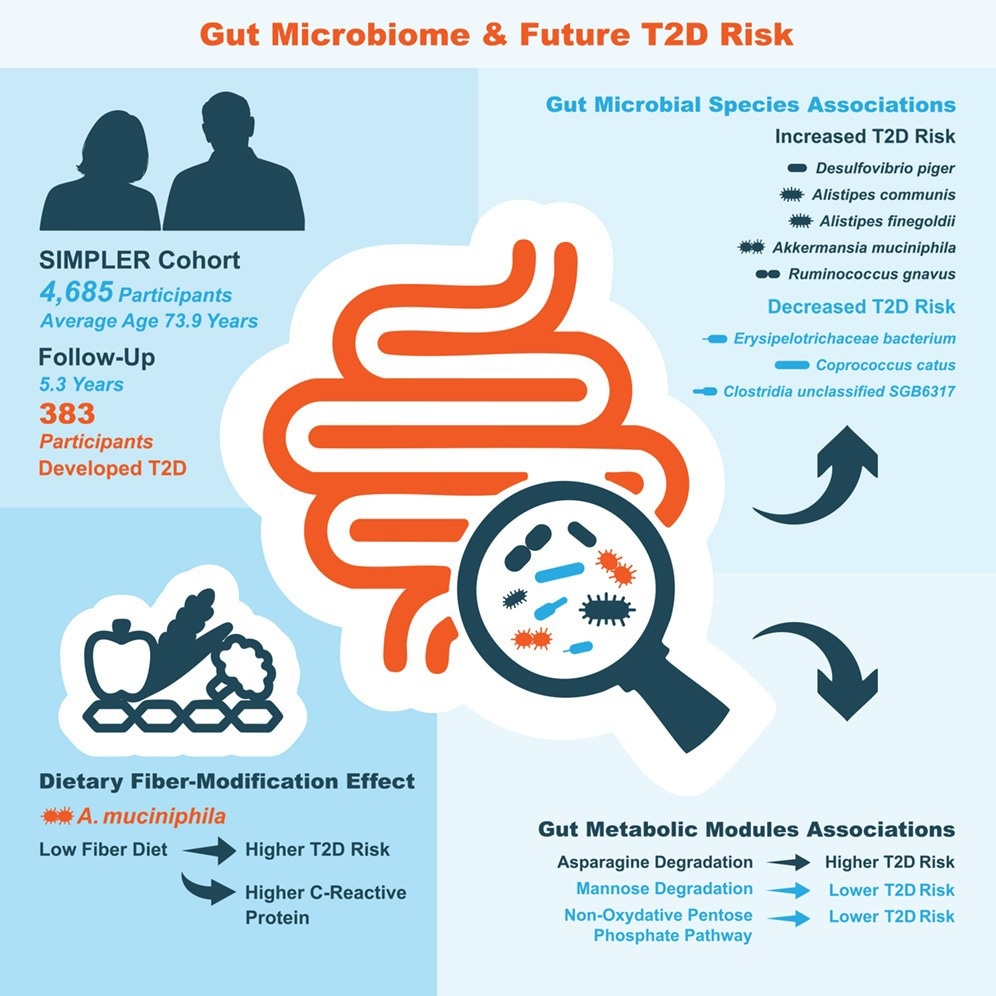
In the present study, researchers investigated associations of gut microbiome features with incident T2D in a large, prospective cohort. They analyzed shotgun metagenomic data of participants in the Swedish Infrastructure for Medical Population-based Life Course and Environmental Research cohort. The full analysis set (FAS) included 4,685 participants aged 73.9 years on average, of whom 383 developed T2D during a median follow-up of 5.3 years.
The lag time analysis set (LTAS) excluded 52 individuals who developed T2D within the first year of follow-up, resulting in 4,633 participants, including 331 incident T2D cases. Microbial features that showed consistent associations with incident T2D after feature selection and Cox regression in both analytical sets were deemed robust. In the FAS, α-diversity was inversely associated with incident T2D, albeit it did not reach statistical significance.
For β-diversity, significant associations were observed between two principal components and increased T2D risk. Nevertheless, these associations disappeared in the LTAS. In the FAS, Elastic Net identified 23 gut microbial species as strong predictors in this analysis set, suggesting that these may constitute a core set of the microbiome relevant to T2D development. Among these, 18 showed a significant association with incident T2D in multivariable Cox regression analysis.
Microbial Species Linked To T2D Risk
Of these, 10 species were positively associated with T2D risk, and eight were inversely associated. The inversely associated species were all from the Firmicutes phylum, while half of the positively associated species were from the Bacteroidetes phylum. Elastic Net selected 17 species as T2D predictors in the LTAS, including 12 identified in the FAS. Of these, nine species showed a significant association with incident T2D in multivariable Cox regression analysis and were considered robustly associated across both analysis sets.
Six species exhibited a positive association with incident T2D: Alistipes communis, Alistipes finegoldii, Akkermansia muciniphila, Desulfovibrio piger, GGB3614 SGB4886 (Lachnospiraceae), and Ruminococcus gnavus.
Further, Erysipelotrichaceae bacterium, Clostridia unclassified SGB6317, and Coprococcus catus were negatively associated with incident T2D. Given the known links of A. muciniphila with dietary fiber intake, the potential modifying effect of fiber intake was assessed.
The association between A. muciniphila and T2D risk was strongest and statistically significant in individuals with the lowest dietary fiber intake (≤ 20 g per day), although formal interaction tests did not confirm significant effect modification for T2D risk. Among incident T2D cases, A. muciniphila abundance was slightly lower in those with higher dietary fiber intake; however, significant differences were noted only in the LTAS. Thus, the authors interpreted the fiber-related pattern cautiously.
Fiber Intake And Inflammation Findings
Among incident T2D cases with data on C-reactive protein (CRP) levels, there was a significant interaction between A. muciniphila abundance and dietary fiber intake on inflammation. Specifically, higher A. muciniphila abundance was associated with higher odds of inflammation in the context of low dietary fiber intake. In contrast, it was associated with reduced odds of inflammation among individuals with high dietary fiber intake.
There was no evidence of A. muciniphila lineage-specific association with incident T2D. Finally, the gut microbiome’s functional potential was characterized using gut metabolic modules (GMMs). Of the 103 GMMs, three showed consistent associations with incident T2D. The asparagine degradation GMM was associated with a higher risk of incident T2D, while the non-oxidative pentose phosphate pathway and mannose degradation GMMs were associated with a lower risk.
Microbiome-Informed Diabetes Prevention Potential
Taken together, the study found that one GMM and six gut microbial species were associated with an increased risk of T2D. In contrast, two GMMs and three species were associated with a lower risk of T2D. Gut microbial diversity was not associated with T2D risk.
Overall, these prospective findings provide insights into the etiology of T2D and, if replicated, may eventually support gut microbiome-informed approaches for T2D risk prediction and prevention. However, the authors cautioned that residual confounding, the older Swedish cohort, single-time-point stool sampling, and the observational design limit causal interpretation and generalizability.
Download your PDF copy by clicking here.
 GLP-1 drugs and SGLT-2 inhibitors linked to slower kidney decline