Sponsored Content by n6Reviewed by Ify IsiborJul 22 2026
Forget the brute-force manual procedures of the past; it is time to kick high-throughput genomics into high gear. By linking icon96 directly to a preferred liquid handler, this system eliminates the need for manual normalization and "batching" altogether.
Whether certifying NGS libraries or pursuing the ideal qPCR curve, this integration guarantees that each well receives personalized, real-time care, allowing users to focus on their end goal. It is time for the robots to take the wheel.
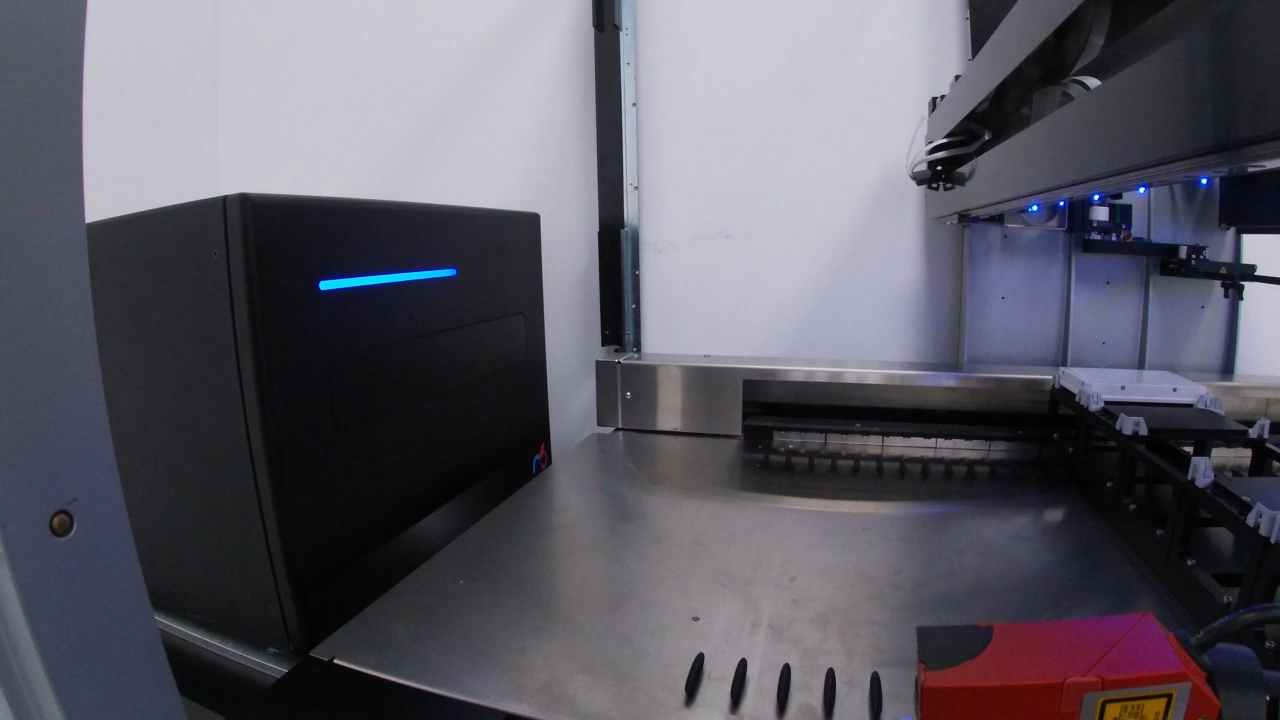 Image Credit: n6
Why integrate?
Icon96 is a piece of precision equipment that uses fluorescence detection and individual well control to amplify, quantify, and normalize NGS libraries. By incorporating icon96 into an automated pipeline, laboratories can unlock:
- Decreased hands-on time: By running samples as they are and pooling them immediately after amplification, users can save up to 60% of hands-on time.
- Reduced costs: AutoNorm™ sample pooling can significantly reduce library-prep expenses for amplicon sequencing while boosting results quality.
- Perfect cycling for every well: Unlike traditional PCR that processes all 96 samples equally, the icon96 method gives separate control and real-time feedback for each sample, reducing dropouts and duplications.
Getting started
To begin, those interested need a lab equipped with an icon96 and their preferred liquid handler.
The API toolbelt
This proof of concept (PoC) uses the n6 Software API to enable the instrument to operate independently within a private network. The system establishes trust for offline use using the trust-on-first-use (TOFU) pattern, and secure access is provided via JSON Web Tokens (JWTs) and login credentials.
The API manages four main areas:
- Authentication: Allows only authorized users to interact with the system
- Devices: Manage linked devices, including drawer operations, status monitoring, reboots, and safe hardware shutdown
- Protocols: Enables viewing, uploading, and listing protocols for execution
- Experiments: Provides full control over 96-well runs, allowing for real-time monitoring and data retrieval
The workflow
Here is a high-level, automated workflow that an automated platform can run:
- System verification: The software checks the instrument for an "idle" state before starting the protocol.
- Drawer operation (open): A command is sent to the endpoint for opening the drawer. The system monitors the device's status until the action is completed.
- Plate loading: After an operator verifies that the plate holder is empty, an external robotic arm places the 96-well plate into the holder.
- Drawer operation (close): The software closes the drawer and waits for the device to indicate completion. The status then returns to "idle".
- Experiment initiation and status monitoring: The system initiates the selected protocol and periodically polls for fluorescence data until it reaches a terminal state (e.g., "completed").
- Plate recovery: The software confirms the device is "idle", opens the drawer, and commands the external robotic arm to retrieve the plate.
- Data retrieval: The software retrieves the necessary run data to download the experiment report.
Video Credit: n6
The bottom line
Connecting icon96 to automation software eliminates the manual bottlenecks and brute-force operations associated with standard NGS library preparation. This proof-of-concept system shows how a fully walk-away integrated system can help labs achieve faster prep, lower operational expenses, and significantly improved data quality.
About n6
n6 is a genomics company focused on simplifying sample prep and helping scientists get better data, faster. As genomics scales, n6 believes workflows should become easier, not harder. Our instruments combine multiple workflow steps into one streamlined process, reducing complexity at any throughput. We partner closely with scientists to remove barriers in the lab and build the tools genomics has always needed, but never had.
Sponsored Content Policy: News-Medical.net publishes articles and related content that may be derived from sources where we have existing commercial relationships, provided such content adds value to the core editorial ethos of News-Medical.net, which is to educate and inform site visitors interested in medical research, science, medical devices and treatments.