Sponsored Content by n6Reviewed by Ify IsiborJul 22 2026
Laboratories have a real and growing sustainability problem. Pipette tips, reagent tubes, 96-well plates, plate seals, and gloves are changed out after each run, meaning that every year, life science laboratories generate more than five million tons of plastic waste, with molecular biology activities such as NGS library preparation accounting for a disproportionate percentage.1
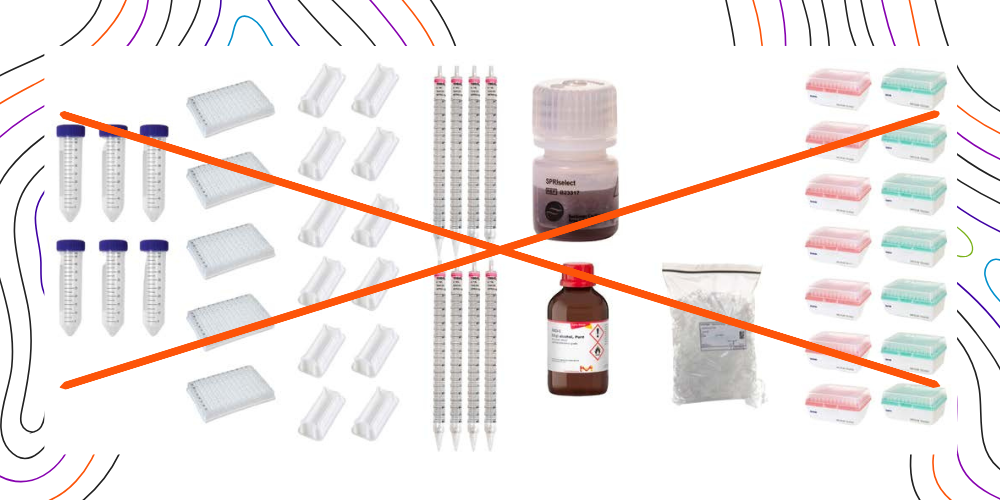
Image Credit: n6
The genetics community is an especially significant contributor. Every sample sent to sequencing goes through a series of independent quantification procedures, normalization operations, and SPRI cleanups, each of which consumes tubes, tips, and reagents that end up in the bin.
The discourse about lab sustainability has progressed well beyond recycling tip boxes. Labs, funders, and institutions are asking a more difficult question: Can procedures be restructured to consume less in the first place?
This strategy, known as protocol miniaturization, entails reducing reaction volumes and eliminating unnecessary steps to minimize sample consumption, reagent costs, and plastic waste by over 80%.2 NGS library preparation, particularly the PCR amplification and normalization phase, is one of the most promising candidates for redesign.
The hidden waste in standard NGS library prep
Most people consider NGS sustainability in terms of reagent amounts. However, the larger waste issue is process redundancy: steps added to a workflow not to improve biology, but because PCR amplification is uncontrolled.
This catalyzes a chain reaction. Traditional fixed-cycle PCR lacks a stop signal. High-input samples overamplify, while low-input samples underamplify.
To compensate, labs do upstream sample quantification, followed by post-PCR library SPRI cleanup, individual library quantification, and normalization. Each of these correcting procedures requires extra pipette tips, reagent tubes, 96-well plates, and hands-on time. These actions do not add value to the process; they simply produce compensatory waste
A single 96-sample batch necessitates 96 additional individual library quantifications, 96 individual clean-up procedures, and dozens of normalization steps, all of which produce plastic and reagent waste.3
Qubit quantification is another layer of concealed waste that frequently goes unnoticed. In a 96-sample NGS approach, each library requires a unique qubit measurement, which consumes 200 µL of fluorometric reagent per sample and generates another round of tubes and tips for the bin.
Benchmarking data demonstrates that icon96 can perform the same fluorometric quantification using only 50 µL per reaction, a 75% reduction in reagent use. It can also process up to 94 samples simultaneously rather than eight at a time, saving an extra 15–30 minutes per run.4
For labs trying to combine instruments and reduce consumable waste at every stage of the workflow, this is a significant win that extends far beyond PCR.
How icon96 changes the equation
The icon96 thermocycler uses iconPCR™ technology and AutoNorm™ software to control amplification at the source, eliminating the need for downstream corrections. Instead of using fixed cycle counts for each sample, iconPCR™ uses real-time fluorescence monitoring to autonomously halt each reaction at its ideal endpoint.
Samples requiring more amplification receive more cycles, and those requiring less receive fewer. The outcome is a plate of naturally balanced, normalized libraries generated during the PCR process, eliminating the necessity for individual post-PCR quantification or normalization processes.5
When it comes to sustainability, the math is simple:3
- 24 fewer workflow touchpoints per 96-sample batch
- 670 pipette tips and reagent tubes eliminated for each plate
- Three hours less hands-on time every run
- Reduced consumable costs by 40–60% with simplified cycling and procedures
- A single pooled cleanup eliminates 96 separate SPRI cleanups
One study found that employing icon96 for Ultima Genomics workflows reduced the use of consumables, tips, tubes, and 96-well plates by more than 95% compared with standard processing methods, as well as being quicker.6 This workflow redesign offers more than incremental improvement.
What about icon16?
The icon16, n6's compact instrument for smaller-batch labs with up to 16 samples per experiment, uses the same AutoNorm technology.5
On a lesser scale, translational research groups, PI laboratories, and clinical research teams confront the same plastic waste problem: individual cleanups, quantifications, and normalizations all pile up.
icon16 eliminates steps and reduces consumables in such situations without requiring a centralized core facility or large throughput volumes: sustainable NGS is no longer limited to manufacturing labs.
Miniaturization, automation, and the bigger picture
The genomics community is increasingly focusing on downsizing and automation as the two key levers of sustainable lab practice.2
Scaling down reaction volumes and eliminating superfluous manual procedures decrease plastic use, CO2 emissions, reagent prices, and the energy footprint of running additional instruments.
Alithea Genomics discovered that multiplexed transcriptomic workflows can reduce plastic use by up to 95% through early sample pooling, the same principle that underpins icon96's design.7
Icon96 fits well into this movement. It is completely interoperable with conventional automated liquid-handling platforms such as Beckman, Hamilton, Tecan, and Opentrons, and it uses standard reagents with no proprietary kits necessary.3
A new environment is not required for sustainability in this context. Rather, it is created by removing stages from the one you now have.
Importantly, icon96 does not compromise on sustainability or data quality, as fewer steps equal fewer failure modes. Similarly, fewer cleanups equal less sample loss. AutoNorm's per-well adaptive control results in improved library balance, fewer sequencing reruns, and reduced unused sequencing capacity.
As Dr. Anja Mezger at SciLifeLab noted, "iconPCR will help us streamline processes by eliminating QC and normalization steps, while also improving data quality by preventing over-amplification of samples”.8
The bottom line for green labs
Labs working toward more sustainable workflows should not have to choose between environmental responsibility and scientific success. Icon96 and icon16 achieve both by addressing the core cause of NGS library prep waste: unregulated PCR amplification, which triggers a cascade of downstream correction actions, each of which consumes plastic and reagents.
Enjoy less guessing, with fewer steps, less waste, and better data.
References and further reading
- Frontline Genomics. (2025, September 8). Sustainability in the Lab: How to Make Your Science Greener.
- Biocompare Editorial. (2024, May 27). Reaction Miniaturization for NGS Library Preparation.
- n6 (2026). Technical Note: High-Throughput DNA Quantification Using the icon96 System - Benchmarking icon96 against the Qubit™ 4 Fluorometer for dsDNA quantification. Available at: https://www.n6tec.com/posters/high-throughput-dna-quantification-using-the-icon96-tm-instrument.
- n6. (2025, October 13). Scale Your NGS Operations with icon96: Where Intelligence Meets Automation [Automation Brochure]. n6tec.com. (Attached document; available for download via form on this page.)
- n6. (2026). n6 iconPCR Sales Enablement Guide v2. Internal document; n6tec.com platform overview. n6tec.com
- n6 / Ultima Genomics. (2025). iconPCR AutoNormalization for Ultima Genomics Sequencing. Available at: https://www.n6tec.com/posters/iconpcr-autonormalization-for-ultima-genomics-sequencing.
- Alithea Genomics. (2025, November 17). Tackling Plastic Waste and CO2 Emissions for Pharma Sustainability: Does Massive Sample Multiplexing Help?
- n6. (2026). Introduction Deck (30 mins) 2026 - Customer testimonial: Dr. Anja Mezger, SciLifeLab. Internal presentation; quote approved for external use per n6 reference site program guidelines.
About n6
n6 is a genomics company focused on simplifying sample prep and helping scientists get better data, faster. As genomics scales, n6 believes workflows should become easier, not harder. Our instruments combine multiple workflow steps into one streamlined process, reducing complexity at any throughput. We partner closely with scientists to remove barriers in the lab and build the tools genomics has always needed, but never had.
Sponsored Content Policy: News-Medical.net publishes articles and related content that may be derived from sources where we have existing commercial relationships, provided such content adds value to the core editorial ethos of News-Medical.net, which is to educate and inform site visitors interested in medical research, science, medical devices and treatments.