Endotoxin, a lipopolysaccharide (LPS) originating from the outer membrane of Gram-negative bacteria, remains one of the most common and difficult contaminants in recombinant protein preparations, particularly those derived from E. coli expression systems or prokaryotic plasmids.
Even at trace levels, endotoxin can trigger strong systemic and neuroinflammatory reactions, changing cellular function and distorting experimental results. As a result, data generated in endotoxin-contaminated systems may be deceptive or even inaccurate, posing significant dangers to preclinical research and downstream decision-making.
Due to its high immunostimulatory and cytotoxic qualities, rigorous control of endotoxin levels is critical in a variety of applications, including immunological investigations, vaccine development, drug discovery, monoclonal antibody manufacturing, and cell and gene therapies.
Endotoxin presents a unique challenge because it is highly heat-stable and resistant to standard removal methods, requiring stringent control throughout both upstream and downstream purification processes.
Sino Biological offers customized production solutions and ProPure™ recombinant proteins, which exceed the industry standard (0.5 EU/mg according to USP <85>). These solutions are specifically designed to support endotoxin-sensitive applications, enabling researchers and developers to obtain more precise, reliable, and reproducible results in both basic research and therapeutic development.
What is endotoxin (LPS)?
Endotoxin, or LPS, consists of three key structural components (Figure 1). The outermost portion, known as the O-antigen, is composed of repeated oligosaccharide units that are highly variable and strain-specific, thereby making them useful for determining the bacterium's serological identity.
The core oligosaccharide is located beneath the O-antigen and is a relatively conserved structural element. Lipid A anchors the molecule and is the most conserved and physiologically active component of endotoxin.
This hydrophobic domain has a highly organized, hexagonal layout, which contributes to its structural stiffness and remarkable stability, features that also make endotoxin difficult to remove during protein purification processes.1
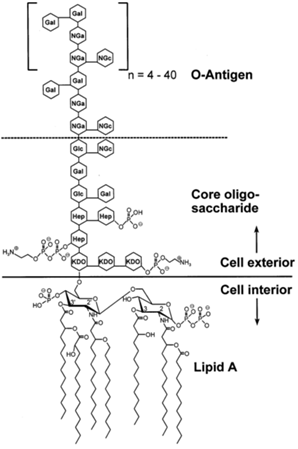
Figure 1. Schematic view of the chemical structure of endotoxin from E. coli O111:B4 according to Ohno and Morrison (1989). Hep, L-glycero-D-manno-heptose; Gal, galactose; Glc, glucose;KDO, 2-keto-3-deoxyoctonic acid; NGa, N-acetyl-galactosamine;NGc, N-acetyl-glucosamine. Image Credit: Petsch, D. (2000)1
Despite its structural complexity, endotoxin's biological effects are mostly mediated by the host immune system.
Rather than directly harming cells or tissues, endotoxin, specifically Lipid A, activates immune cells such as monocytes and macrophages. This activation catalyzes the production of a wide range of powerful mediators, including tumor necrosis factor (TNF), interleukins, and platelet-activating factor.2
Prevalence of endotoxin contamination
In biotechnological production processes, it is important to determine the source of endotoxin contamination, whether it is internal to the production system or introduced through non-sterile conditions (Figure 2).3
Requirements can differ greatly depending on whether the product is employed for diagnostic or therapeutic purposes. However, for high-dose therapies, such as serum albumin or monoclonal antibodies, even minor endotoxin contamination is unsatisfactory due to the high total exposure.3
In these cases, effective techniques are needed to eliminate residual endotoxin traces left after traditional purification processes.
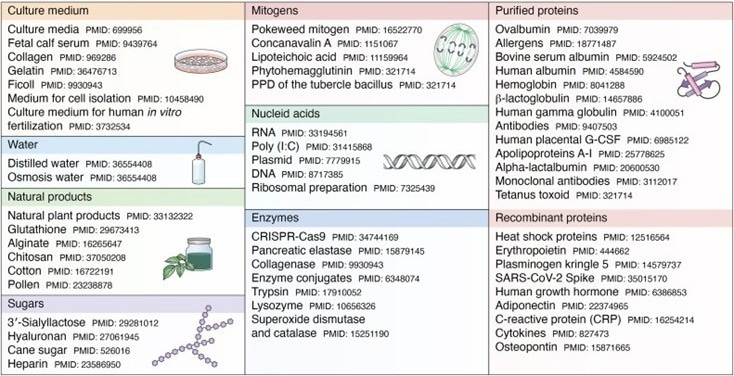
Figure 2. Endotoxin contamination is diverse and ubiquitous. List of publications with PubMed identifiers dealing with recognized endotoxin contamination of various products that can be encountered during biological experiments. Image Credit: Bonhomme, D., et al. (2024).3
Endotoxin is also found in the environment, with humans most often exposed through dust in agricultural and industrial operations, textiles, and even houses and offices. The diversity and prevalence of human exposure to endotoxin mean that contamination must be controlled at all phases of protein production.3
Endotoxin risks in experiments and assays
Even small amounts of endotoxin can silently compromise experiments, particularly antibody production. Endotoxin contamination alters the human immune response, meaning it can diminish antibody quality, specificity, and consistency, thereby limiting the reliability of results.
Endotoxin management is essential in delicate applications such as:
- Conducting preclinical toxicological and PK investigations with little immune influence
- Immunization of animals for high-quality antibody production
- Reliable in vitro cell tests for proliferation and differentiation
- Accurate cytokine detection to provide solid immunological insights
There is a well-cited example in animal vaccination studies for antibody production. Researchers examining heat shock protein-antigen fusion vaccines found that the apparent improvement in immunostimulatory potential of E. coli-derived HSP70-ovalbumin fusion proteins was largely due to endotoxin contamination rather than the biological activity of the fusion itself.
In vivo immunization with recombinant fusion proteins effectively stimulated antigen-specific cytotoxic T-cell responses. However, after endotoxin removal, this immunostimulatory effect was completely lost (Figure 3).4
This case exemplifies how invisible endotoxin contamination can skew interpretations of immune activation and antibody production in preclinical investigations, underlining the importance of strict endotoxin control in immunology research.
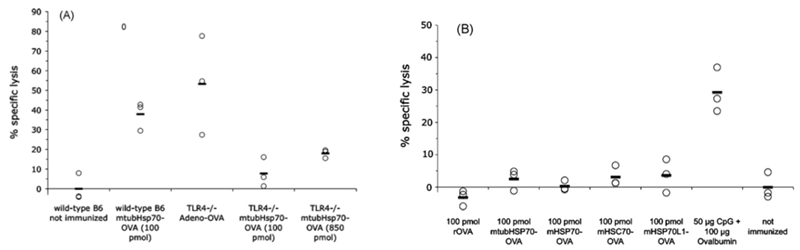
Figure 3. Endotoxin contamination is responsible for the immunogenicity of HSP70-OVA fusion proteins. Wild-type and TLR4-deficient C57BL/6 mice were immunized with Hsp70-OVA (A) and endotoxin-depleted recombinant Hsp70-OVA (B). The induced ovalbumin-specific cytotoxicity was measured in an in vivo CTL assay. Image Credit: Boris-Christian Marincek, et al. (2008).4
In another important study published in PLoS ONE, Schwarz and colleagues revealed that even extremely low levels of residual endotoxin, similar to those found in commercially available recombinant proteins, are sufficient to activate human immune cells and alter cytokine responses.5
LPS concentrations as low as ∼0.02 ng/mL were found to induce cytokine production, including IL-6 (Figure 4). This range is comparable to the level of endotoxin contamination observed in conventional protein preparations.
These findings demonstrate that even minor endotoxin contamination can have a considerable impact on immunological signaling and cytokine assays, emphasizing the importance of sensitive endotoxin screening and removal.
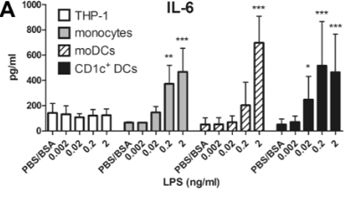
Figure 4. 1×10⁵ THP-1 cells, primary human monocytes, monocyte-derived DCs (moDCs), or CD1c+ DCs were either stimulated with different concentrations of LPS or solvent (PBS/BSA) as a control. Image Credit: Schwarz, H., et al. (2014).5
How Sino Biological controls endotoxin to the ProPure™ level
Pharmacopeial guidelines, such as USP <85>, offer basic limits for endotoxin, but cutting-edge immunology and translational oncology investigations often demand much stricter control.
Sino Biological's ProPure™ endotoxin-free recombinant proteins eliminate this variability at its source, ensuring consistent findings from early discovery to IND (investigational new drug) investigations.
ProPure™ reagents, manufactured at the cutting-edge Center for Bioprocessing (C4B) in Texas, are rigorously controlled to achieve levels as low as 0.05 EU/mg, with select items attaining an unprecedented 0.01 EU/mg, over 10 times lower than conventional industry norms (Table 1).
Table 1. Sino Biological ProPure™ partial product list with endotoxin levels that meet industry standards. Source: Sino Biological Inc.
| Molecule |
Cat# |
Species |
Purity |
Endotoxin Level |
Activity |
| EGFR |
10001-H08H-UE |
Human |
SEC-MALS verified |
<0.01 EU/mg |
ELISA, BLI |
| Her2/ERBB2 |
10004-H08H-UE |
Human |
SEC-MALS verified |
<0.05 EU/mg |
ELISA, BLI |
| VEGFR2/KDR |
10012-H08H-UE |
Human |
SEC-MALS verified |
0.03 EU/mg |
Cell activity |
| 4-1BB/CD137 |
10041-H08H-UE |
Human |
SEC-MALS verified |
0.01 EU/mg |
ELISA |
| PD-L1/B7-H1 |
10084-H08H-UE |
Human |
SEC-MALS verified |
0.005 EU/mg |
ELISA, BLI |
| M-CSFR/CSF1R |
10161-H08H-UE |
Human |
SEC-MALS verified |
<0.05 EU/mg |
ELISA |
| CD25/IL-2R alpha |
10165-H08H-UE |
Human |
SEC-MALS verified |
0.01 EU/mg |
Cell activity, BLI |
| HER3/ERBB3 |
10201-H08H-UE |
Human |
SEC-MALS verified |
0.09 EU/mg |
ELISA |
| AXL |
10279-H08H-UE |
Human |
SEC-MALS verified |
<0.05 EU/mg |
ELISA, SPR |
| IL-13 |
10369-H01H-UE |
Human |
SEC-MALS verified |
0.1 EU/mg |
ELISA |
| PD-1 |
10377-H08H-UE |
Human |
SEC-MALS verified |
<0.01 EU/mg |
ELISA, BLI |
| CD16a/FCGR3A |
10389-H08H-UE |
Human |
SEC-MALS verified |
<0.1 EU/mg |
SPR, BLI |
Propure™ endotoxin-free guarantee
End-stage cleanup alone is not sufficient to achieve ProPure™ quality. C4B implements an integrated Prevention-Isolation-Detection method throughout the production process.
- Prevention at the source: To prevent LPS introduction, endotoxin-free plasmids and buffers, low-endotoxin-binding polymers, and strict CIP techniques should be used throughout the cloning and purifying processes.
- Environmental isolation: The facility's environmental isolation eliminates E. coli, a common source of endotoxin in recombinant protein manufacturing.
- Dual detection: Each batch undergoes dual detection using LAL and/or rFc assays to provide sensitive, redundant detection and traceability of results.

Image Credit: Sino Biological Inc.
This end-to-end design ensures that ProPure™ proteins arrive ready to be used in the most demanding oncology and immunology applications, without requiring additional purification steps that could harm protein quality or delay process timelines.
Sino Biological employs cutting-edge methods and equipment to produce high-quality, endotoxin-free proteins that fulfill the requirements of even the most delicate research and translational applications.
The company’s strict quality control assures low endotoxin levels at all stages of production. In addition, Sino Biological's C4B provides unique endotoxin-free protein expression services that are specifically tailored to the strict endotoxin requirements of preclinical and drug development research.
C4B's modern instrumentation, enhanced purification procedures, and rigorous in-house endotoxin controls ensure >90 % purity and endotoxin levels below the detection limit (<0.05 EU/mg).
References
- Petsch, D. (2000). Endotoxin removal from protein solutions. Journal of Biotechnology, 76(2-3), pp.97–119. DOI: 10.1016/s0168-1656(99)00185-6. https://www.sciencedirect.com/science/article/abs/pii/S0168165699001856?via%3Dihub.
- Forehand, J.R., et al. (1989). Lipopolysaccharide priming of human neutrophils for an enhanced respiratory burst. Role of intracellular free calcium. 83(1), pp.74–83. DOI: 10.1172/jci113887. https://www.jci.org/articles/view/113887.
- Bonhomme, D., et al. (2024). The dangerous liaisons in innate immunity involving recombinant proteins and endotoxins: examples from the literature and the Leptospira field. Journal of Biological Chemistry, 300(1), pp.105506–105506. DOI: 10.1016/j.jbc.2023.105506. https://www.jbc.org/article/S0021-9258(23)02534-6/fulltext.
- Boris-Christian Marincek, et al. (2008). Heat shock protein–antigen fusions lose their enhanced immunostimulatory capacity after endotoxin depletion. Molecular Immunology, 46(1), pp.181–191. DOI: 10.1016/j.molimm.2008.07.039. https://www.sciencedirect.com/science/article/abs/pii/S0161589008003349?via%3Dihub.
- Schwarz, H., et al. (2014). Residual Endotoxin Contaminations in Recombinant Proteins Are Sufficient to Activate Human CD1c+ Dendritic Cells. PLoS ONE, 9(12), p.e113840. DOI: 10.1371/journal.pone.0113840. https://journals.plos.org/plosone/article?id=10.1371/journal.pone.0113840.
About Sino Biological Inc.
Founded in 2007, Sino Biological is a global biotechnology company specializing in high-quality recombinant proteins, antibodies, and CRO services. Serving researchers in over 90 countries, Sino Biological supports basic research, drug discovery, vaccine development, and diagnostics through its comprehensive product portfolio, proprietary quality systems, and innovative research platforms.
Sino Biological's core business
Sino Biological is a leading global biotechnology supplier dedicated to high-quality research reagents and comprehensive CRO services. Its extensive product portfolio covers over 9,800 recombinant proteins, 15,000 antibodies, and 50,000 genes, all produced in-house. As a trusted CRO partner, Sino Biological specializes in customized recombinant protein and antibody production. It stands out with its robust high-throughput antibody production system including HEK293/CHO and cell‑free platforms. This system enables rapid turnaround (as fast as 5 days), high-throughput production (>10,000 Abs/month) and cost-effective solutions for global academic and pharmaceutical clients.
Sponsored Content Policy: News-Medical.net publishes articles and related content that may be derived from sources where we have existing commercial relationships, provided such content adds value to the core editorial ethos of News-Medical.net, which is to educate and inform site visitors interested in medical research, science, medical devices, and treatments.