Nipah virus (NiV), a lethal animal-borne RNA virus belonging to the Henipavirus genus, causes severe encephalitis and respiratory disease, with case fatality rates ranging from 40 to 75 %. Since its discovery in Malaysia in 1999, periodical outbreaks have occurred across South and Southeast Asia.1 Sino Biological, a key provider of viral reagents, offers a comprehensive range of Nipah virus research tools, empowering scientists to develop broad-spectrum therapeutics crucial for managing outbreaks and preparing for future pandemics.
NiV structure and pathogenesis
NiV is a negative‑sense, single‑stranded RNA virus carrying a large genome of approximately 18.2 kb that encodes six structural proteins. The virions, which are virus particles, have multiple shapes but are often spherical or filamentous in NiV. The virions range in diameter from 120 to 500 nm and are enclosed by a lipid envelope that protects them.
The Nipah virus G protein binds ephrin-B2/B3 on endothelial cells and neurons, and its F protein facilitates pH-independent membrane fusion and syncytia formation, promoting its neurotropism and virulence.1-3
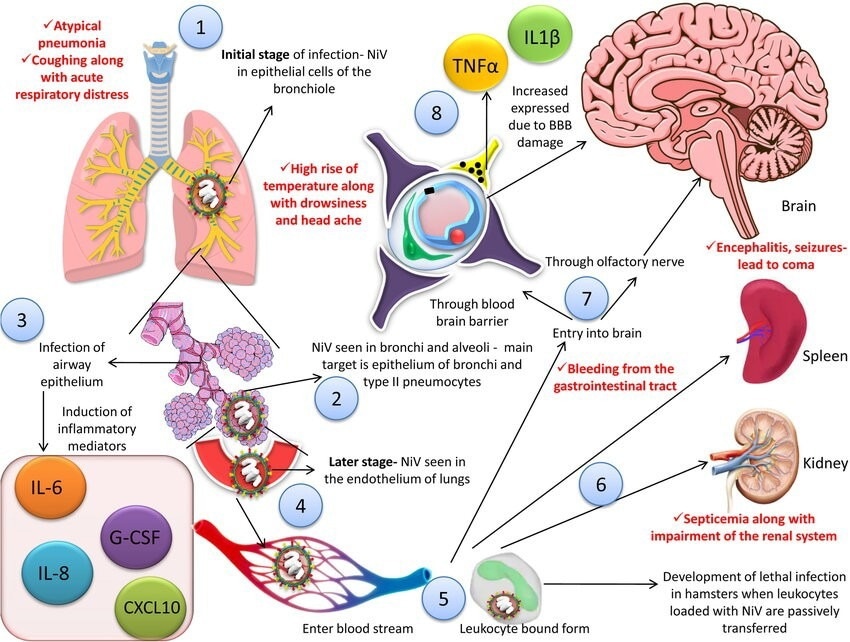
Pathogenesis of NiV: The virus first infects bronchiolar and alveolar epithelial cells, causing local inflammation and the release of inflammatory mediators. It then spreads to pulmonary endothelial cells, enters the bloodstream (free or within infected leukocytes), and disseminates to the brain, spleen, and kidneys. NiV reaches the central nervous system (CNS) via the hematogenous route and anterograde transport along olfactory nerves, leading to BBB disruption and upregulation of IL‑1β and TNF‑α, which drive the development of neurological symptoms in humans (shown in red). Image Credit: Singh RK, et al. (2019)
Immune evasion of NiV
NiV employs several sophisticated immune evasion mechanisms that contribute to high viral loads and severe illness. The P gene encodes multiple non‑structural proteins (P, V, C, W) interfering with type I interferon (IFN‑α/β) signaling by blocking STAT1/STAT2 phosphorylation and nuclear translocation, thereby weakening the body’s antiviral response.3 The V protein also targets MDA5 and RIG‑I, further suppressing IFN production.
Some research also suggests that the NiV V protein can interfere with the classical complement pathway, reducing the immune system's ability to tag and destroy infected cells. This combination of neurotropism, endothelial damage, and immune suppression explains the high case fatality (40–75 %) and the risk of hospital-acquired infections.4
Designing vaccines and therapeutics based on structure
Developing effective vaccines and antibodies relies heavily on understanding the structure and function of NiV’s surface glycoproteins. The G protein possesses a receptor‑binding domain (RBD) that specifically binds ephrin‑B2/B3, while the F protein exists in a metastable prefusion state on the virion surface and is cleaved by host furin into F1 and F2, becoming fusion‑competent.5
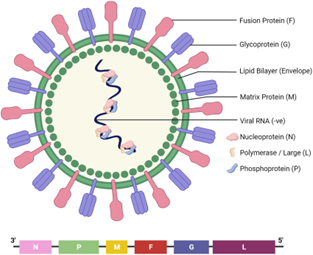
Nipah virus (NiV) has six structural proteins: nucleoprotein (N), phosphoprotein (P), matrix protein (M), fusion protein (F), receptor‑binding glycoprotein (G), and RNA‑dependent RNA polymerase (L).6 Image Credit: Al-Obaidi MMJ, et al. (2024)
Most vaccine candidates are engineered using recombinant NiV G or F proteins, virus‑like particles (VLPs), or viral vectors (such as vesicular stomatitis virus, VSV, or adenovirus) that express NiV glycoproteins. Preclinical studies in hamster and ferret models have demonstrated that immunization with prefusion‑stabilized F or soluble G elicits high‑titer neutralizing antibodies and protects against lethal NiV challenge. mRNA‑based platforms are also being explored, encoding NiV G or prefusion F to stimulate strong humoral and cellular immune responses.
Neutralizing monoclonal antibodies (mAbs)
A significant therapeutic approach for NiV involves neutralizing monoclonal antibodies (mAbs), with several candidates undergoing preclinical and early-stage development. Potent mAbs typically target either the G protein RBD (blocking receptor binding) or the prefusion F protein (preventing conformational changes required for fusion).7,8
Key functional assays to characterize these mAbs include:
- Pseudovirus neutralization tests (PNT) using VSV or lentiviral pseudotypes displaying NiV G and F, allowing safe, high‑throughput screening in BSL‑2 labs.
- Live‑virus plaque reduction neutralization tests (PRNT) in BSL‑4 laboratories to confirm neutralization potency.
- Effector function assays (e.g., ADCC, phagocytosis) to evaluate Fc‑mediated clearance of infected cells.9
Structural studies using Cryo‑EM and X‑ray crystallography studies of mAb–NiV glycoprotein complexes are employed to identify neutralizing epitopes, map escape mutations, and guide engineering of broad‑spectrum mAbs effective against strains from Malaysia (NiV‑M) and Bangladesh (NiV‑B), as well as related henipaviruses.9
Sino Biological’s role in translational NiV research
Sino Biological supports this translational research by supplying recombinant NiV reagents used in academic and industrial labs worldwide. Their product portfolio includes:
- Recombinant NiV G protein (both NiV‑M and NiV‑B strains) produced in mammalian cells, with high affinity for ephrin‑B2/B3, used as antigens in ELISA, AlphaLISA, and as immunogens for mAb generation.
- Recombinant NiV F protein, typically in a prefusion‑stabilized form, which is critical for screening neutralizing mAbs and evaluating vaccine‑induced responses.
- cDNA clones of NiV G and F genes, enabling rapid expression of viral glycoproteins for pseudovirus neutralization assays, immunogenicity studies, and epitope mapping.
Providing well‑characterized and functionally validated NiV proteins as well as molecular tools allows Sino Biological to accelerate the discovery of broadly neutralizing mAbs, structure‑guided vaccine design, and the development of rapid, sensitive diagnostic assays needed for outbreak response and pandemic preparedness.
References
- Chua, K.B. (2000). Nipah Virus: A Recently Emergent Deadly Paramyxovirus. Science, 288(5470), pp.1432–1435. DOI: 10.1126/science.288.5470.1432. https://www.science.org/doi/10.1126/science.288.5470.1432.
- Singh, R.K., et al. (2019). Nipah virus: epidemiology, pathology, immunobiology and advances in diagnosis, vaccine designing and control strategies – a comprehensive review. Veterinary Quarterly, 39(1), pp.26–55. DOI: 10.1080/01652176.2019.1580827. https://www.tandfonline.com/doi/full/10.1080/01652176.2019.1580827.
- Rodriguez, J.J., Parisien, J.-P. and Horvath, C.M. (2002). Nipah virus V protein evades alpha and gamma interferons by preventing STAT1 and STAT2 activation and nuclear accumulation. Journal of Virology, (online) 76(22), pp.11476–11483. DOI: 10.1128/jvi.76.22.11476-11483.2002. https://journals.asm.org/doi/10.1128/jvi.76.22.11476-11483.2002.
- Eichhorn G, et al. (2015). A novel factor I activity in NiV inhibits human complement pathways. Journal of Virology, 89(2):1133-43. DOI: 10.1128/JVI.02459-14 A novel factor I activity in Nipah virus inhibits human complement pathways through cleavage of C3b - PubMed
- Negrete, O.A., et al. (2005). EphrinB2 is the entry receptor for Nipah virus, an emergent deadly paramyxovirus. Nature, 436(7049), pp.401–405. DOI: 10.1038/nature03838. https://www.nature.com/articles/nature03838.
- Al-Obaidi MMJ, et al. (2024). Nipah Virus Neurotropism: Insights into Blood-Brain Barrier Disruption. Journal of Integrative Neuroscience, 23(5), pp.90–90. DOI: 10.31083/j.jin2305090. https://www.imrpress.com/journal/JIN/23/5/10.31083/j.jin2305090.
- Nie, J., et al. (2019). Nipah pseudovirus system enables evaluation of vaccines in vitro and in vivo using non-BSL-4 facilities. Emerging Microbes & Infections, 8(1), pp.272–281. DOI: 10.1080/22221751.2019.1571871. https://www.tandfonline.com/doi/full/10.1080/22221751.2019.1571871.
- Bossart, K.N., et al. (2009). A Neutralizing Human Monoclonal Antibody Protects against Lethal Disease in a New Ferret Model of Acute Nipah Virus Infection. PLoS Pathogens, 5(10), p.e1000642. DOI: 10.1371/journal.ppat.1000642. https://journals.plos.org/plospathogens/article?id=10.1371/journal.ppat.1000642.
- Avanzato, V.A., et al. (2019). A structural basis for antibody-mediated neutralization of Nipah virus reveals a site of vulnerability at the fusion glycoprotein apex. Proceedings of the National Academy of Sciences of the United States of America, (online) 116(50), pp.25057–25067. DOI: 10.1073/pnas.1912503116. https://www.pnas.org/doi/full/10.1073/pnas.1912503116.
About Sino Biological Inc.
Founded in 2007, Sino Biological is a global biotechnology company specializing in high-quality recombinant proteins, antibodies, and CRO services. Serving researchers in over 90 countries, Sino Biological supports basic research, drug discovery, vaccine development, and diagnostics through its comprehensive product portfolio, proprietary quality systems, and innovative research platforms.
Sino Biological's core business
Sino Biological is a leading global biotechnology supplier dedicated to high-quality research reagents and comprehensive CRO services. Its extensive product portfolio covers over 9,800 recombinant proteins, 15,000 antibodies, and 50,000 genes, all produced in-house. As a trusted CRO partner, Sino Biological specializes in customized recombinant protein and antibody production. It stands out with its robust high-throughput antibody production system including HEK293/CHO and cell‑free platforms. This system enables rapid turnaround (as fast as 5 days), high-throughput production (>10,000 Abs/month) and cost-effective solutions for global academic and pharmaceutical clients.
Sponsored Content Policy: News-Medical.net publishes articles and related content that may be derived from sources where we have existing commercial relationships, provided such content adds value to the core editorial ethos of News-Medical.net, which is to educate and inform site visitors interested in medical research, science, medical devices and treatments.