TNF superfamily (TNFSF) proteins are essential regulators of both inflammation and immune homeostasis.1 A large number of TNFSF proteins will naturally assemble as homotrimers, with this key structural feature regarded as an essential factor in downstream signaling and receptor binding.2
Members such as TNF-α, TL1A, RANKL, BAFF, and CD70 are central to B-cell function, inflammatory signaling, immune activation, and tumor immunity.3,4,5
Their roles in these pathways have made these members attractive targets for the development of novel immunotherapies, biologics, and next-generation therapeutic modalities.
Sino Biological offers a wide range of high-quality, native-like TNFSF trimer proteins designed to support drug discovery and therapeutic target research.
The physiological and pathological roles of TNF-family trimers
TNFSF proteins are important regulators of immune homeostasis, coordinating immune cell activation, survival, proliferation, and effector functions.
TNFSF signaling maintains balanced immune responses under physiological conditions, supporting communication between immune and non-immune cells.6 A significant number of TNFSF members act as homotrimers, a key structural feature that is necessary for both efficient receptor engagement and downstream signaling.2
Dysregulated TNFSF activity can lead to aberrant B-cell responses, excessive inflammation, immune dysfunction, and tumor immune evasion. It can also contribute to the development of chronic inflammatory disorders, autoimmune diseases, and cancer.
These characteristics have led to the emergence of TNFSF proteins as valuable therapeutic targets and biomarkers for next-generation immunotherapies and biologics.
TNFSF signaling depends on ligand trimerization and receptor clustering, meaning that recombinant proteins able to preserve native trimeric architecture are effective tools for therapeutic antibody discovery, mechanistic studies, and translational research.
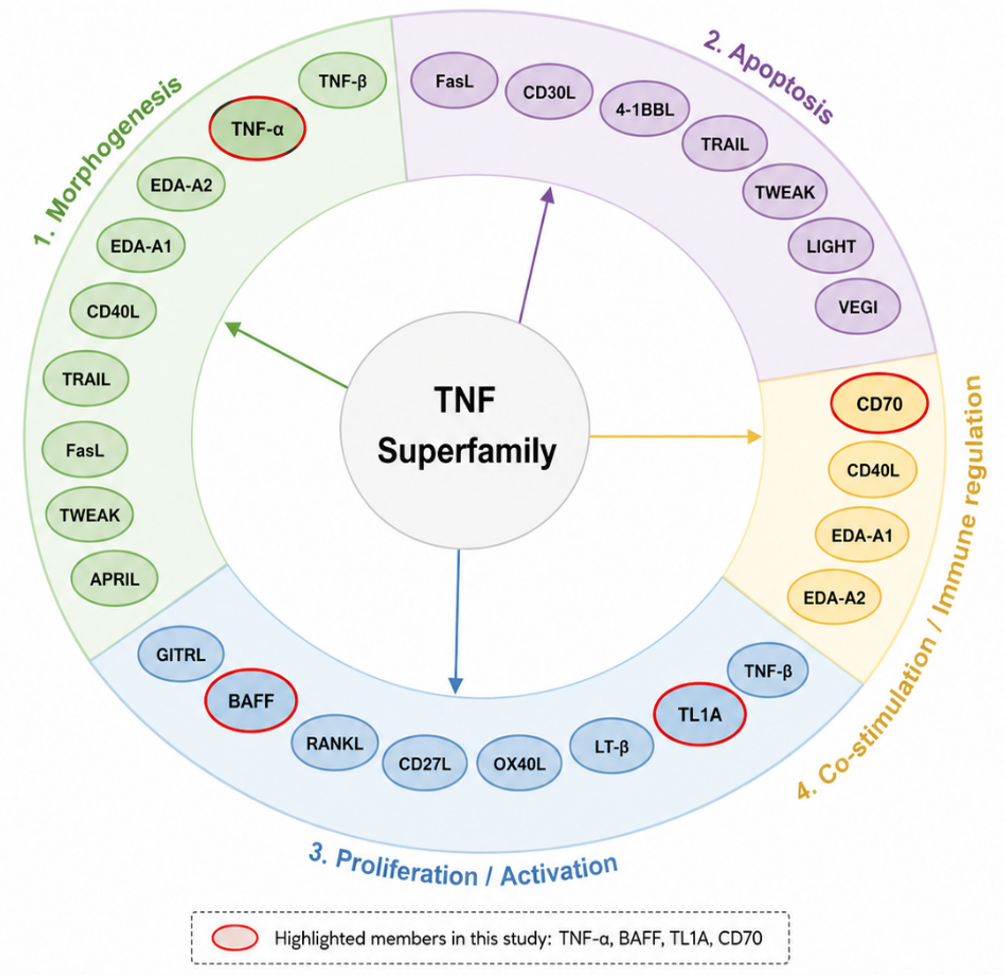
Figure 1. Functional classification of TNF superfamily members. Image Credit: Sino Biological Inc.
Translational and clinical validation of TNFSF targeting
The clinical success of TNFSF-targeted therapies underscores the importance of precisely modeling TNFSF biology during antibody discovery, target validation, and therapeutic development.
Revolutionary therapies targeting TNF-α and RANKL have confirmed the therapeutic value of TNFSF family members across bone disorders, chronic inflammatory diseases, and immune-mediated conditions, successfully establishing TNFSF proteins as a useful, clinically validated target class.
TL1A-, BAFF-, and CD70-directed therapeutics have recently broadened the clinical impact of TNFSF-targeted interventions in cancer and autoimmune diseases.
BAFF-targeted therapies have also shown efficacy in systemic lupus erythematosus,7 with CD70- and TL1A-directed therapeutics garnering considerable attention as encouraging treatment options for cancer and inflammatory bowel disease.8,9
This range of promising advances underscores the increasing translational and therapeutic impact of TNFSF-targeted drug development.
Table 1. Representative TNFSF-targeted therapeutics and clinical development programs. Source: Sino Biological Inc.
| TNFSF Member |
Major Indications |
Representative
Therapeutic Programs |
Development
Status |
| TNF-α (TNFSF2) |
Rheumatoid arthritis, psoriasis,
IBD |
Humira®, Remicade®,
Enbrel® |
Approved |
| BAFF (TNFSF13B) |
Systemic lupus erythematosus |
Benlysta® |
Approved |
| APRIL (TNFSF13) |
Multiple myeloma, autoimmune diseases |
Atacicept |
Late-stage clinical |
| CD40L (TNFSF5) |
Autoimmune diseases, transplantation |
Dapirolizumab pegol |
Phase III |
| CD70 (TNFSF7) |
Hematologic malignancies, solid tumors |
ADCs, TCEs, CAR-T
therapies |
Clinical development |
| 4-1BBL (TNFSF9) |
Cancer immunotherapy |
4-1BB agonist programs |
Clinical development |
| OX40L (TNFSF4) |
Autoimmune diseases, cancer |
OX40/OX40L-targeted antibodies |
Clinical development |
| TRAIL (TNFSF10) |
Solid tumors, hematologic malignancies |
TRAIL receptor agonists |
Clinical development |
| RANKL (TNFSF11) |
Osteoporosis, bone metastasis |
Prolia® (denosumab),
Xgeva® |
Approved |
| TL1A (TNFSF15) |
Inflammatory bowel disease |
MK-7240, RVT-3101 |
Phase III |
Research applications of native-like TNFSF trimer proteins
Native-like trimeric TNFSF proteins facilitate biologically relevant receptor engagement and downstream signaling.
For instance, Dave et al. used recombinant human TNF-α protein (Cat# 10602-HNAE) and cynomolgus/rhesus TNF-α protein (Cat# 90018-CNAE) in a DLS assay to characterize antibody–antigen complex formation (Figure 2).
Recombinant human RANKL protein (Cat# 11682-HNCH) was used in another study to induce osteoclast differentiation from human PBMCs in the presence of M-CSF. This approach helped to support osteoporosis research and bone remodeling (Figure 3).
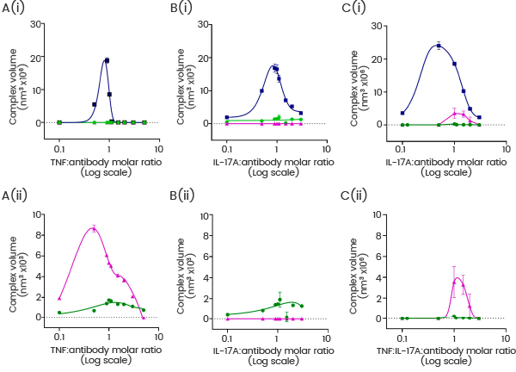
Figure 2. Antibody: antigen complex formation with individual or combined antigen addition. DLS was used to measure the complex volumes (nm3) formed by TrYbe®, DVD-IgG, and FynomAb when combined at defined molar ratios with (a, i) TNF, (b, i) IL-17A, or (c, i) both TNF and IL-17A. Panels (ii) display magnified views of the corresponding plots (a–c) to highlight the smaller complexes formed by TrYbe® and FynomAb, where applicable. Image Credit: https://doi.org/10.1080/19420862.2022.2160229
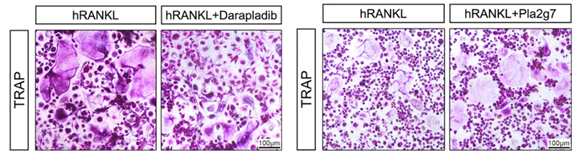
Figure 3. Human PBMCs were stimulated with recombinant human RANKL and M-CSF to induce osteoclast differentiation. Representative TRAP staining images show the formation of multinucleated osteoclasts under RANKL-induced conditions. Image Credit: https://doi.org/10.1038/s41467-025-66285-8
Native-like TNFSF trimer proteins from Sino Biological
Sino Biological offers a complete portfolio of high-quality, native-like TNFSF trimer proteins designed to accelerate drug discovery and therapeutic target research.
These recombinant proteins enable biologically relevant experimental models for functional characterization, antibody discovery, and translational research by preserving the native trimeric structure necessary for efficient receptor activation and downstream signaling.
Batch-to-batch consistency, high quality, and reproducible experimental results are assured as each of these products is thoroughly validated for biological activity and purity using orthogonal analytical and functional assays.
Validated Native-Like TNFSF Trimer Proteins. Source: Sino Biological Inc.
| Molecule |
Cat# |
Species |
Purity Verified |
Activity
Validated |
| TL1A (TNFSF15) |
17049-H07H2 |
Human |
SDS-PAGE, SEC-MALS |
SPR |
| TL1A (TNFSF15) |
5A7685-M07H1-UE |
Mouse |
SDS-PAGE, SEC-MALS |
SPR |
| BAFF (TNFSF13B) |
10056-HNCH |
Human |
SDS-PAGE, SEC-HPLC |
Cell-based assay |
| BAFF (TNFSF13B) |
10056-H42H-B |
Human |
SDS-PAGE, SEC-MALS |
ELISA |
| APRIL (TNFSF13) |
10610-H07H2 |
Human |
SDS-PAGE, SEC-MALS |
SPR |
| APRIL (TNFSF13) |
91072-C01H |
Human |
SDS-PAGE, SEC-MALS |
SPR |
| CD70 (TNFSF7) |
10780-H07H5 |
Human |
SDS-PAGE, SEC-HPLC |
ELISA |
| CD70 (TNFSF7) |
51129-M07H2 |
Mouse |
SDS-PAGE, SEC-HPLC |
ELISA |
| RANKL (TNFSF11) |
11682-HNCH |
Human |
SDS-PAGE, SEC-MALS |
Cell-based assay |
| OX40L (TNFSF4) |
13127-H07H |
Human |
SDS-PAGE, SEC-MALS |
ELISA |
| OX40L (TNFSF4) |
13127-H07H-B |
Human |
SDS-PAGE, SEC-MALS |
ELISA |
References and further reading
- Croft, M., et al. (2024). Targeting the TNF and TNFR superfamilies in autoimmune disease and cancer. Nature reviews. Drug discovery, 23(12), pp.939–961. DOI:10.1038/s41573-024-01053-9. https://www.nature.com/articles/s41573-024-01053-9.
- McMillan, D., et al. (2021). Structural insights into the disruption of TNF-TNFR1 signalling by small molecules stabilising a distorted TNF. Nature Communications, 12(1), p.582. DOI:10.1038/s41467-020-20828-3. https://www.nature.com/articles/s41467-020-20828-3.
- Naismith, J.H. and Sprang, S.R. (1998). Modularity in the TNF-receptor family. Trends in biochemical sciences, 23(2), pp.74–9. DOI:10.1016/s0968-0004(97)01164-x. https://www.cell.com/trends/biochemical-sciences/abstract/S0968-0004(97)01164-X.
- Schweighoffer, E. and Tybulewicz, V.L. (2021). BAFF signaling in health and disease. Current Opinion in Immunology, 71, pp.124–131. DOI:10.1016/j.coi.2021.06.014. https://www.sciencedirect.com/science/article/pii/S0952791521000832?via%3Dihub.
- So, T. (2022). The immunological significance of tumor necrosis factor receptor-associated factors (TRAFs). International immunology, 34(1), pp.7–20. doi:10.1093/intimm/dxab058. https://academic.oup.com/intimm/article/34/1/7/6359092.
- Šedý, J., Bekiaris, V. and Ware, C.F. (2015). Tumor necrosis factor superfamily in innate immunity and inflammation. Cold Spring Harbor perspectives in biology, 7(4), p.a016279. DOI:10.1101/cshperspect.a016279. https://cshperspectives.cshlp.org/content/7/4/a016279.
- Boneparth, A. and Davidson, A. (2012). B-cell activating factor targeted therapy and lupus. Arthritis research & therapy, 14 Suppl 4(Suppl 4), p.S2. DOI:10.1186/ar3920. https://link.springer.com/article/10.1186/ar3920.
- Enrico Tettoni, et al. (2025). TL1A as a Target in Inflammatory Bowel Disease: Exploring Mechanisms and Therapeutic Potential. International Journal of Molecular Sciences, 26(11), pp.5017–5017. DOI:10.3390/ijms26115017. https://www.mdpi.com/1422-0067/26/11/5017.
- Kumar, S., et al. (2025). A mechanistic, functional, and clinical perspective on targeting CD70 in cancer. Cancer letters, 611, p.217428. DOI:10.1016/j.canlet.2024.217428. https://www.sciencedirect.com/science/article/pii/S0304383524008231?via%3Dihub.
Acknowledgments
Produced from materials originally authored by Sino Biological.
About Sino Biological Inc.
Founded in 2007, Sino Biological is a global biotechnology company specializing in high-quality recombinant proteins, antibodies, and CRO services. Serving researchers in over 90 countries, Sino Biological supports basic research, drug discovery, vaccine development, and diagnostics through its comprehensive product portfolio, proprietary quality systems, and innovative research platforms.
Sino Biological's core business
Sino Biological is a leading global biotechnology supplier dedicated to high-quality research reagents and comprehensive CRO services. Its extensive product portfolio covers over 9,800 recombinant proteins, 15,000 antibodies, and 50,000 genes, all produced in-house. As a trusted CRO partner, Sino Biological specializes in customized recombinant protein and antibody production. It stands out with its robust high-throughput antibody production system including HEK293/CHO and cell‑free platforms. This system enables rapid turnaround (as fast as 5 days), high-throughput production (>10,000 Abs/month) and cost-effective solutions for global academic and pharmaceutical clients.
Sponsored Content Policy: News-Medical.net publishes articles and related content that may be derived from sources where we have existing commercial relationships, provided such content adds value to the core editorial ethos of News-Medical.net, which is to educate and inform site visitors interested in medical research, science, medical devices, and treatments.