World Arthritis Day, observed each year on October 12, serves as a reminder of the widespread impact of this highly disabling disease. Rheumatoid Arthritis (RA), one of its most severe forms, impacts the health and quality of life of around 23.7 million individuals across the world.
Image Credit: ACROBiosystems
In addition to causing joint swelling, pain, and stiffness, RA is a systemic autoimmune disorder. It can extend far beyond the joints to the heart, lungs, vasculature, and other organs. Without early, consistent treatment, up to 30 % of patients may experience significant disability within just five years of diagnosis.
Despite popular belief, RA is not restricted to the elderly. Its peak onset occurs between the ages of 35 and 50, predominantly impacting young and middle-aged adults. Women are affected at nearly three times the rate of men.
The disease is driven by aberrant immune activation, in which the immune system mistakenly attacks synovial tissue, resulting in chronic inflammation and progressive destruction of the joints.
An incurable disease, RA is characterized by symmetric, recurrent inflammation of the small joints in the hands, wrists, and feet. Systemic complications frequently accompany these symptoms and can ultimately lead to loss of joint function and disability.
ACROBiosystems provides an extensive range of tools to support RA research, including high-activity recombinant proteins, stable cell lines, and inhibitor screening kits.
These solutions cover the full therapeutic development range, from target discovery and validation, candidate drug screening and development, to CMC production and quality control. Each tool aids in streamlining the path from basic research to clinical application, accelerating the development of new RA treatments.
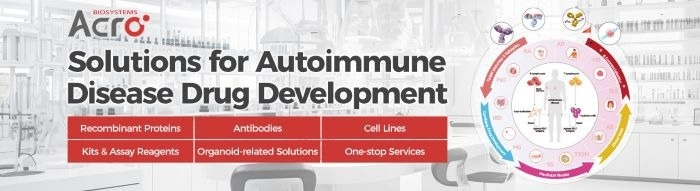
Image Credit: ACROBiosystems
Pathogenetic mechanisms of RA: Why the immune system attacks its own joints
RA starts with aberrant immune activation in the synovium. The combined influence of both genetic predisposition (e.g., HLA-DRB1 alleles) and environmental triggers causes the synovium to gradually transform into tertiary lymphoid-like structures populated by activated macrophage-like and fibroblast-like synoviocytes.
These cells produce elevated levels of proinflammatory cytokines, including IL-1, IL-6, and TNF-α, along with matrix metalloproteinases (MMPs), all of which drive chronic inflammation and tissue destruction. At the same time, antigen presentation activates CD4+ T cells, which differentiate into pathogenic subsets such as Th17 cells. These cells produce cytokines, including IL-17A, IL-17F, IL-22, and GM-CSF, that further contribute to the inflammatory cascade.
Meanwhile, the function of regulatory T cells (Tregs) (typically essential for immune suppression) is compromised in the proinflammatory milieu. Together, these mechanisms promote synovial hyperplasia, the formation of invasive pannus tissue, and the recruitment of further immune cell infiltrates.
During RA progression, B cells intensify autoimmunity through several mechanisms. Upon activation, these cells differentiate into plasma cells that produce rheumatoid factor (RF) and anti-citrullinated protein antibodies (ACPA).
ACPAs activate the complement cascade, trigger neutrophil extracellular trap (NET) formation, and crosslink Fc receptors to stimulate macrophage release of TNF-α, forming a self-perpetuating inflammatory loop.
The innate immune system also plays a role in sustaining inflammation. Classically activated M1 macrophages release abundant proinflammatory mediators, while dendritic cells and innate lymphoid cells (ILCs) amplify immune responses, with ILC3 cells secreting IL-17 and IL-22.
In contrast, ILC2 cells and regulatory B cells (Bregs), which usually contribute to immune tolerance, are significantly diminished during active disease, weakening immunoregulatory capacity. This disparity between innate and adaptive immunity powers a vicious cycle that perpetuates synovial inflammation and ultimately leads to irreversible joint damage.
Power shift in RA therapeutics: From TNF-α dominance to a landscape of diverse innovation
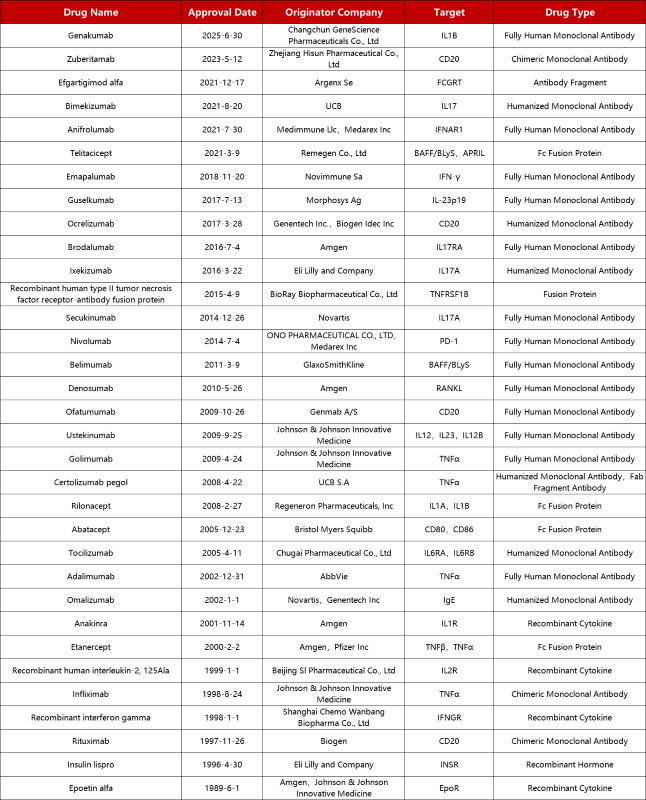
The RA therapeutics market has matured into a threefold landscape: TNF-α inhibitors forming the traditional backbone, rapid expansion of emerging pathway treatments, and accelerated breakthroughs from novel drugs.
As the first widely adopted biologics, TNF-α inhibitors have historically dominated the RA market. AbbVie’s adalimumab has generated over $200 billion in cumulative sales across two decades and held the title of the world’s best-selling drug for 10 years.
Despite losing this position after patent expiration in 2023 and the emergence of biosimilars, adalimumab remains a standard in the autoimmune therapeutics industry. Similarly, infliximab and etanercept have experienced declines in market share due to patent expirations, with 2024 global sales falling 12.8 % and 10 % year-over-year, respectively.
To address growing clinical demands, treatments targeting upstream inflammatory pathways, especially IL-17 and IL-23 inhibitors, are becoming mainstream. Novartis’s secukinumab exceeded $6.2 billion in 2024 sales, while Eli Lilly’s ixekizumab surpassed $3.6 billion, both sustaining double-digit growth thanks to superior clinical response rates.
Morphosys’s guselkumab, utilizing accurate inhibition of the IL-23p19 subunit, achieved $3.6 billion in global revenue in 2024, a 16.6 % year-over-year increase, solidifying its role as a dual growth driver in both RA and psoriasis.
At the same time, B cell modulating drugs remain crucial. Biogen’s rituximab (anti-CD20) and Rongchang Bio’s telitacicept (dual blockade of BAFF and APRIL to restrict aberrant B cell activation) reflect a diversified approach and expanding presence in the market.
The RA therapeutics market has recently progressed along two parallel tracks: breakthrough innovation and expanded indications. In October 2023, Novartis’s secukinumab gained approval for long-term RA maintenance treatment, making it the first IL-17 monoclonal antibody demonstrated to slow structural joint damage.
In March 2024, Eli Lilly’s ixekizumab was approved for domestic use in patients with insufficient response to tocilizumab, offering a targeted option for difficult-to-treat populations. Concurrently, biosimilar uptake is accelerating, boosting market competition and broadening cost-effective therapy options, especially for patients transitioning from established biologics.
Approved originator biologics for RA. Source: Pharmacodia
ACROBiosystems pioneers RA therapeutics with innovative solutions
ACROBiosystems has built an extensive suite of tools for RA studies, including high-activity recombinant proteins, stable cell lines, and inhibitor screening kits. These solutions support every stage of drug development, accelerating the efficient translation of advanced RA treatments from basic studies to clinical adoption.
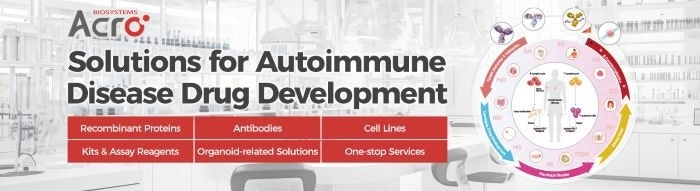
Image Credit: ACROBiosystems
Hot RA target recommendations
Source: ACROBiosystems
| |
|
|
|
|
| CD19 |
BCMA |
CD3E & CD3D |
FcRn |
CD20 |
| PD-1 |
Complement C5 |
TNF-alpha |
CD3E & CD3G |
CD28 |
| IL-6 |
IL-17A |
CD40 |
CD40 Ligand |
BAFFR |
| MAdCAM-1 |
B7-1 |
LAG-3 |
CTLA-4 |
IL-1 beta |
| IL-2 R beta & IL-2 R alpha & IL-2 R gamma |
B7-2 |
IL-6 R alpha |
BTLA |
| IL-1 Rrp2 |
TNF-beta |
IL-1 RI |
CD3 gamma |
Neuropilin-2 |
| G-CSF |
... |
|
|
|
References and further reading:
- Gao, Y.-F., Zhao, N., and Hu, C.-H. (2025). Harnessing mesenchymal stem/stromal cells-based therapies for rheumatoid arthritis: mechanisms, clinical applications, and microenvironmental interactions. Stem Cell Research & Therapy, 16(1). DOI: 10.1186/s13287-025-04495-z. https://link.springer.com/article/10.1186/s13287-025-04495-z.
- Gao, Y., Zhang, Y. and Liu, X. (2024). Rheumatoid arthritis: pathogenesis and therapeutic advances. MedComm, (online) 5(3). DOI: 10.1002/mco2.509. https://onlinelibrary.wiley.com/doi/10.1002/mco2.509.
- Inchingolo, F., et al. (2024). Management of Rheumatoid Arthritis in Primary Care: A Scoping Review. International journal of environmental research and public health/International journal of environmental research and public health, 21(6), pp.662–662. DOI: 10.3390/ijerph21060662. https://www.mdpi.com/1660-4601/21/6/662.
- Guo, Q., et al. (2018). Rheumatoid arthritis: Pathological mechanisms and modern pharmacologic therapies. Bone Research, 6(1). DOI: 10.1038/s41413-018-0016-9. https://www.nature.com/articles/s41413-018-0016-9.
About ACROBiosystems
ACROBiosystems is a cornerstone enterprise of the pharmaceutical and biotechnology industries. Their mission is to help overcome challenges with innovative tools and solutions from discovery to the clinic. They supply life science tools designed to be used in discovery research and scalable to the clinical phase and beyond. By consistently adapting to new regulatory challenges and guidelines, ACROBiosystems delivers solutions, whether it comes through recombinant proteins, antibodies, assay kits, GMP-grade reagents, or custom services. ACROBiosystems empowers scientists and engineers dedicated to innovation to simplify and accelerate the development of new, better, and more affordable medicine.
Sponsored Content Policy: News-Medical.net publishes articles and related content that may be derived from sources where we have existing commercial relationships, provided such content adds value to the core editorial ethos of News-Medical.net, which is to educate and inform site visitors interested in medical research, science, medical devices, and treatments.